

The Peace Bridge in Calgary is one of the city’s most recognizable structures. The bridge seamlessly blends functionality with an elegant design that harmonizes beautifully with the urban landscape. Spanning the Bow River, the Peace Bridge provides a safe and picturesque route for pedestrians and cyclists alike. In this article on calgary-future, we’ll cover the bridge’s history and its unique architectural features.
The Story Behind the Construction
In 2008, the City of Calgary allocated $25 million for the construction of a new bridge across the Bow River. Construction officially began in March 2010. To bring the design to life, the city commissioned the renowned Spanish architect Santiago Calatrava. Calatrava is also a sculptor and artist, celebrated globally for his distinctive bridges, railway stations, stadiums, museums, and sculptures.
The tubular bridge structure was fabricated in Spain and then shipped to Calgary. It was installed in 2011, but during a weld inspection, it was discovered that some of the welds did not meet quality standards. As a result, the bridge’s opening was significantly delayed. The Peace Bridge finally opened to the public on March 24, 2012.
Architectural Highlights
The bridge’s design is a stunning combination of steel and glass. Bright red metal “ribs” create a rhythmic pattern, while glass panels ensure ample natural lighting inside. The bridge lacks traditional supporting cables, which adds a sense of lightness and modernity to the structure. The Peace Bridge’s striking bright red colour stands in bold contrast to Calgary’s natural scenery and skyscrapers. This colour choice is unusual for Calatrava, as most of his projects feature white or grey structures. He chose red because it’s used on both the Canadian flag and the City of Calgary flag. The colour successfully transformed the bridge into a distinct architectural accent for the city.
The bridge was engineered to withstand Calgary’s once-in-a-century flood cycle and is expected to have a minimum service life of 75 years. The Peace Bridge ensures barrier-free access for people of all mobility types. Furthermore, modern lighting makes it safe and comfortable to use both in the evening and at night.
A Venue for Public Events

The bridge has gained recognition in part due to the important events that regularly take place here. For example, in January 2022, a rally in support of Ukraine was held on the bridge. About 20 people gathered to express their solidarity with Ukrainians at a time when Russia was massing troops near the Ukrainian border.
An anti-racism rally also took place here in March 2022. Dozens of Calgarians gathered to call on the government to take action against racial discrimination. The rally was organized in commemoration of the International Day for the Elimination of Racial Discrimination.
Unfortunately, alongside these significant events, the bridge has frequently been targeted by vandalism. In its first four years alone, the bridge suffered damages totalling over $200,000.
The “RedBall Project”
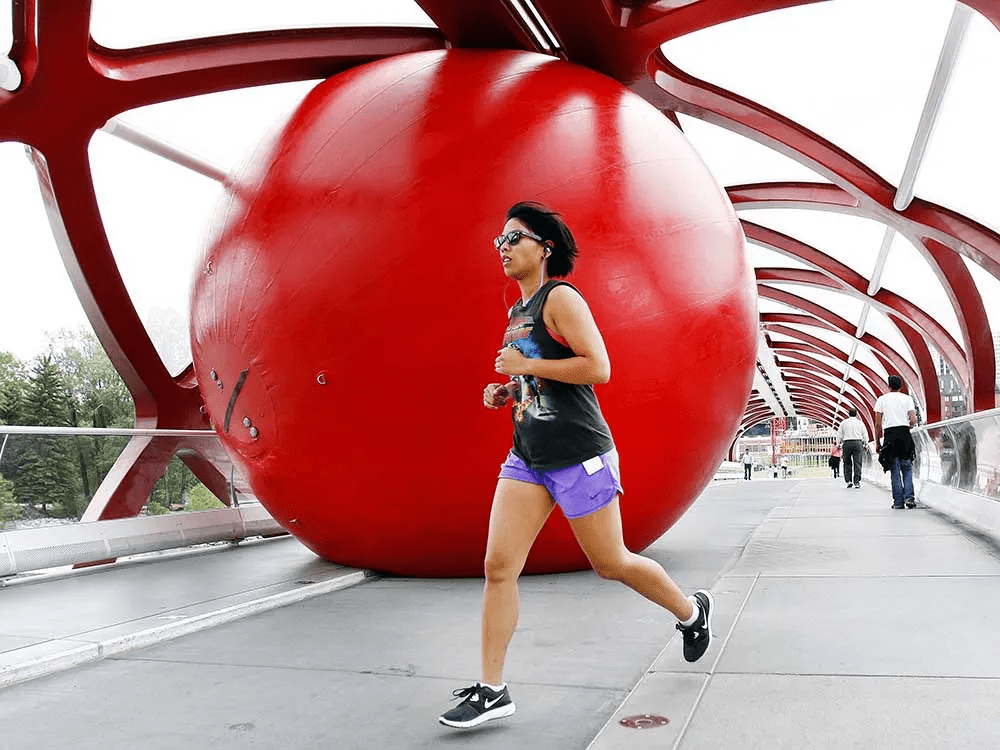
On June 26, 2017, the bridge hosted the “RedBall Project,” an art installation by American artist Kurt Perschke. This 15-foot inflatable red ball travels to various cities around the world. The “RedBall” possesses a charismatic, magnetic nature that appeals to everyone. The strength of this project lies in how the ball invites the viewer into a moment of play and collective imagination. Moreover, the ball interacts with each city uniquely, offering a fresh perspective on the familiar sights and places we see every day.
The art installation encouraged Calgarians to view their familiar streets through the lens of play and artistic experimentation. The unexpected presence of the ball in the city created a sense of surprise. People stopped to take photos, share their impressions, and converse with others, transforming the urban space into a site for cultural interaction and dialogue.